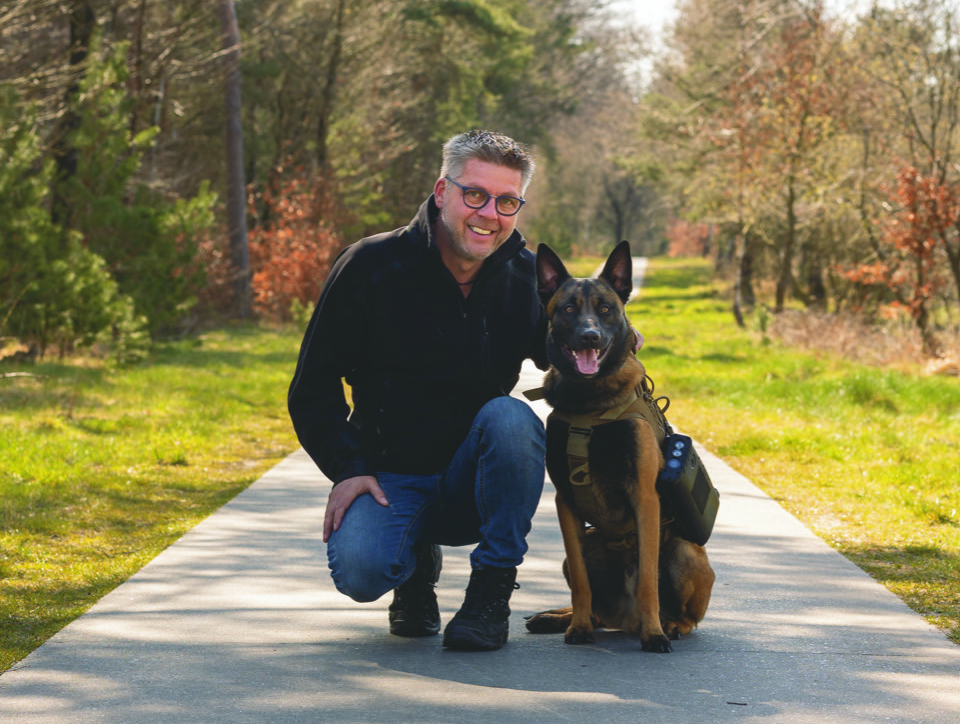
A profile of Simon Prins
Learning from the experts is a crucial step in the journey to becoming a better dog trainer – but how expert is the expert?
How can we be confident that those who set themselves up in positions of authority really have the in-depth knowledge and practical skills that will guide and enrich our own training?
In the case of Simon Prins, author of the highly successful Dog Training Decoded, there is no contest. Simon has been successful in taking on seemingly impossible challenges, which would leave most of us floundering. His ground-breaking work includes developing a training programme for radio-guided camera dogs, fitting dogs with sensors enabling them to carry small robots into covert operations, and masterminding programmes focused on hard surface tracking, laser-guided attack dogs, and detection dogs for special operations.
Success was not instantaneous; it was the result of accumulating knowledge, collecting data, and not being scared of failure.
Simon’s career started in the Dutch Armed Forces, where he became the youngest student to graduate as a military diver. He was also interested in training dogs, in particular, using hunting dogs to track down poachers. When he moved to the police, he was able to find an outlet for this burgeoning passion and became a police dog handler.
The path was not easy. Back then, the simple rule was:
If the dog does something you don’t like, punish him.
If he does something you like, don’t punish him.
And in that way, he learns what is required.
Simon was not allowed to use food in training session, play ball, or do anything else that was ‘enjoyable’ with his dog. His first ‘training lessons’ involved adherence to strict obedience, and punishment. At this stage, he had no idea how to achieve results without coercion, but he felt sure there was a better way. Hebecame determined to discover how he could attain the training goals that were required in the tough world of police dog handling, using more positive methods. His gut feeling was that much more could be achieved if dog and handler understood each other better, and could build trust in each other.
Fast forward to where we are today and, thankfully, police dog handling has undergone a transformation. Simon, among other enlightened trainers and handlers, was instrumental in bringing about change until it reached a point where the turnaround was irreversible. Along the way, he was called a misfit, a rebel, a trickster, and a troublemaker, but he says: “I took that as a positive because, at the end of the day, misfits are the people who are crazy enough to think they can change the world!”
When positive training methods have been put in place, all things become possible, But the challenges Simon faced in 1996, when he was recruited to join a newly formed covert unit, represented a whole new level. The aim of the unit was to use dogs for tactical purposes, and he was tasked with:
Training a ‘silent’, passive drug detection dog to take on covert operations.
At the time, drug detection dogs were known for their aggressive barking.
Training a dog that could follow a track in an urban environment.
Back then, tracking dogs only worked in rural areas.
Equipping a dog with a camera system, and other sensors, and training him to go into an unknown, dangerous situations, out of sight of his handler.
This meant finding a way to covertly communicate with the dog over long distances, sending him into an operational area without prior training.
Simon understood the essentials of disciplines such as searching for drugs, explosives, or people, but training a ‘remote controlled’ camera dog was something else. How do you learn about something that doesn’t exist?
The big breakthrough came when Simon had an afternoon off and, recalling happy childhood memories, he went to the local dolphinarium to watch a dolphin show. He said: “Sitting in the audience, I was enjoying the show when, suddenly, I felt as though I had been struck by lightning. At that time I was having problems with just one dog, on a long leash, when I tried to send him in various directions. Yet this trainer was giving directional commands to five animals without using a training aid, or any form of compulsion. The dolphins’ co-operation stemmed from trust in their trainer, and a sense of fun and enjoyment”.
This was the stepping stone Simon needed. He learnt more about the methodologies used for training dolphins and his research took him to America to world-renowned animal trainer, Bob Bailey, and his wife Marian, who were championing operant conditioning using clickers – and chickens. After much persuasion Bob – who was wary of police dog trainers because of their reputation for using coercive methods – allowed Simon to become one of his students. This was the start of a rewarding and fruitful collaboration which lasts to the present day.
During this time, Simon has written numerous training protocols and books, and invented innovative training apparatus. In 2002 he handpicked and trained 16 dogs and their handlers to initiate USAR, a dedicated search and rescue operation. And his pioneering approach took another step forward in 2006 when he began merging dogs and electronics, outfitting radio-directional dogs with sensors and enabling them to carry small robots into operations. He has worked with a multitude of dogs and trainers from special police and miltary units across the world, seeking to bridge the gap between scientific knowledge and practical training to optimise the effectiveness of operational dogs. Simon is now known as a distinguished author, speaker, innovator, and specialist in animal behaviour and training. He leads his own company, ACT!, where he continues to innovate within the remit of police and military K9 training.
These are outstanding achievements by any reckoning, but even more remarkable are the insights into dogs and handlers Simon has gained from working with operant conditioning and positive training methods. Now, at long last, we can learn from him in his remarkable Dog Training Decoded where Simon shares his discoveries.
This is a story about bridging the gap between trainers, dog handlers and scientists. It’s about real-life operations. It’s about failure and success. It’s about discovering the value of collecting and analysing data, and how to draw on scientific research. It is a manual on how to train dogs, but it will also give you new insights into training and behaviour and – perhaps the biggest challenge of all – it will help you to motivate trainers and handlers to work with positive reinforcement and to discard punishment as a means of changing behaviour.